
Best AI for Fanfiction: ChatGPT, Claude, NovelAI & Sudowrite Compared
Fanfic Studio
9/29/2026
Best AI for Fanfiction: ChatGPT, Claude, NovelAI & Sudowrite Compared
The best AI for fanfiction is not always the model with the biggest name. A good fanfic writer has to handle canon notes, character voice, ship dynamics, slow-burn pacing, and longfic continuity without turning every scene into a generic story prompt.
Based on official product documentation and real writer discussions, the short answer is this:
- Claude is often praised by users for prose quality and character-driven scenes.
- ChatGPT is strong for planning, restructuring, brainstorming, and revision workflows.
- NovelAI is useful when you want interactive story continuation with memory and lorebook controls.
- Sudowrite is built around fiction workflows, especially brainstorming, rewriting, and story planning.
- Gemini is more of a general assistant, but it can help brainstorm ideas and drafts inside Google's ecosystem.
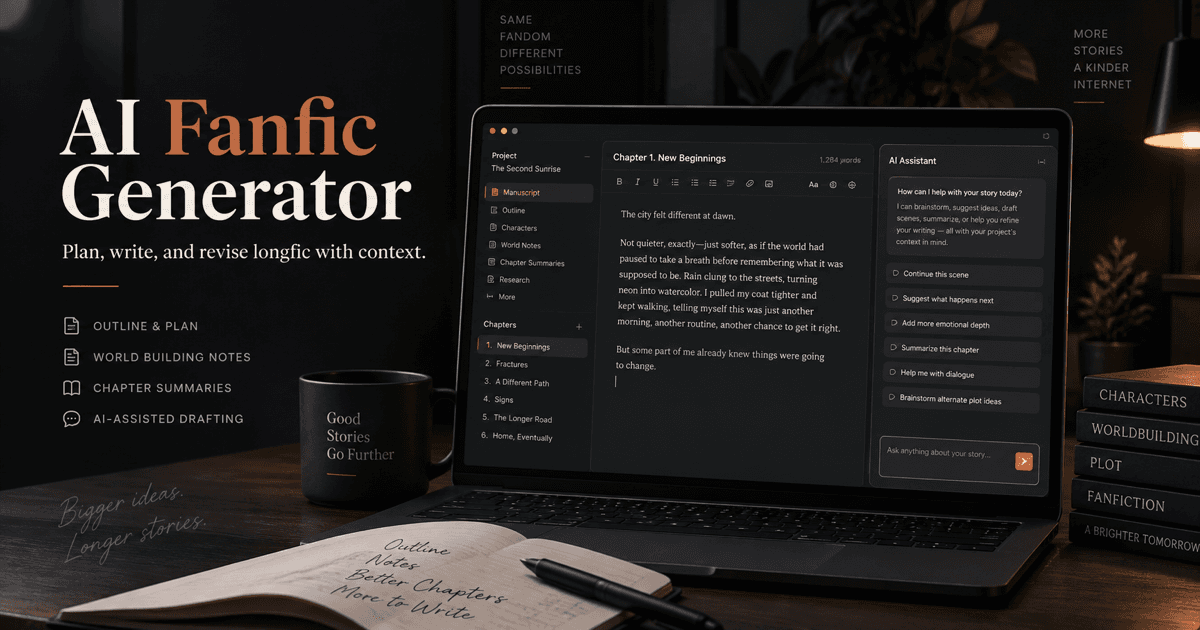
- Fanfic Studio is best when you want a fanfiction generator tied to a project workspace for chapters, notes, and revisions.
None of these tools replaces the writer. The useful question is narrower: which one helps with the part of fanfiction you actually repeat?
What Fanfiction Writers Actually Need From AI
Fanfiction writing has different requirements from generic story generation. A tool can produce fluent prose and still fail if it loses the ship dynamic, ignores a canon rule, or forgets why a scene mattered three chapters ago.
The strongest fanfic AI workflows usually support four things:
- Context control: character notes, canon details, timeline rules, AU setup, and emotional stakes.
- Revision control: the ability to accept, reject, rewrite, or reshape output instead of treating it as finished prose.
- Continuity memory: enough structure to keep longfic chapters from drifting.
- Consent and privacy awareness: especially if you are working with another person's fic, unpublished drafts, or fandom material that is not yours to upload elsewhere.
Official product pages mostly talk about writing in broad terms. Fanfic users talk about the hard part: getting a model to stay emotionally and narratively faithful over time.
What Real Users Say About AI Fanfiction Tools
Community feedback is not a lab test, but it is useful because fanfiction writers tend to notice the problems general AI demos hide: voice drift, surprise trope changes, weak emotion, and lost continuity.
On Reddit, one user comparing AI engines for fanfiction said they were not surprised by Claude ranking highly:
I don't use AI for my prose (enjoy writing my own too much and have a writer's muse ego that just can't deal XD) but I'm so not surprised Claude's the winner.
Source: r/WritingWithAI discussion on AI engines for fanfiction
Another writer, testing ChatGPT against an already-written fanfic chapter, found a common weakness: the model drifted away from the requested fandom setup. Their example was blunt:
when it comes to fanfiction from popular fandoms like Harry Potter or Sherlock, it can't stick to the prompt.
Source: r/AO3 comparison thread
Longfic users also report that context management matters more than a single "best model." In a fan fiction writing thread, one user described using outlines, beats, shorter chapter chunks, and fresh chats because long sessions can get unstable:
after 5 or so chapters, i start a new chat and keep on going
Source: r/WritingWithAI thread on fan fiction writing
There is also a strong consent issue in fan communities. In one AO3 thread, a writer described feeling hurt after learning a reader had been putting their longfic into ChatGPT to generate continuation chapters:
it hurt my chest.
Source: r/AO3 thread about a reader uploading a longfic into ChatGPT
The practical lesson is not "never use AI." It is that fanfic writers should use AI on their own material, disclose when appropriate, avoid uploading other people's work without permission, and keep human control over the final draft.
Official Guidance: What the Major AI Tools Say They Are Good For
Official documentation is useful because it tells you how each tool is positioned by its maker. It does not tell you whether a model will write your favorite pairing well, but it does show the intended workflow.
OpenAI describes ChatGPT as useful for drafting, rewriting, adjusting tone, and turning rough notes into clearer writing. Its writing guidance frames the workflow as planning, drafting, revising, and packaging, which makes ChatGPT a better fit for structure and revision than for unattended longfic generation. See OpenAI's Writing with ChatGPT guide.
Anthropic says Claude can write across formats and styles, including "a screenplay or a novel." That matches the way many fanfic users talk about Claude: useful for prose, scene shaping, and character-driven writing. See Anthropic's Claude use cases.
Google's Gemini help pages include creative prompts such as brainstorming short story ideas. That makes Gemini a reasonable brainstorming assistant, especially if you already use Google products, but its official positioning is broader than fiction-specific fanfic writing. See Google's Gemini Apps help.
NovelAI's documentation emphasizes story controls such as Memory, Author's Note, and Lorebook entries. Its Lorebook docs explain that entries can be inserted into context so the model can use relevant information during generation. That is directly relevant to fanfiction because fandom stories live or die by recurring characters, places, powers, and timeline facts. See the NovelAI Lorebook documentation.
Sudowrite is more explicit about fiction workflow. Its docs describe brainstorming, planning, writing, editing, Rewrite, and Quick Edit. Story Bible gathers core story elements so the AI can reference them later, but Sudowrite also cautions that the result depends on the writer directing it. See What is Sudowrite? and What is Story Bible?.
AO3 is a separate question. In an official AO3 admin post, the Archive stated that, at that time, its Terms of Service did not prohibit fully or partly AI-generated fanworks if they otherwise qualified as fanworks, while also noting that policies were under internal discussion. See AO3's AI and Data Scraping on the Archive post. That is not the same as community acceptance, and it does not override fandom etiquette.
Best AI for Fanfiction by Use Case
Character-driven scenes and prose: Claude
Claude is a strong fit when you want prose, dialogue, and character emotion. Its official use cases include long-form creative writing, and community comments often praise its scene quality. The watch-out: it can still drift, soften conflict, or need clear pacing instructions.
Planning, summaries, and revision: ChatGPT
ChatGPT is a strong fit when you need outlines, summaries, prompt cleanup, scene restructuring, or multiple rewrite options. It is less ideal as an unchecked source of facts or canon details, so verify anything factual before using it.
Lore-heavy interactive writing: NovelAI
NovelAI is a strong fit when you want memory-style story controls. Memory, Author's Note, and Lorebook entries make it useful for recurring characters, locations, powers, and timeline rules. The trade-off is setup time: the output depends heavily on how well you prepare the context.
Fiction workflow from brainstorm to rewrite: Sudowrite
Sudowrite is a strong fit when you want a writing suite rather than a plain chat box. Brainstorm, Rewrite, Quick Edit, and Story Bible are built around fiction workflows. The limitation is the same one Sudowrite itself points toward: the story is only as good as the writer directing it.
Fast creative brainstorming: Gemini
Gemini is a reasonable fit for quick ideas, especially if you already work inside Google tools. It is less fanfic-specific than NovelAI, Sudowrite, or Fanfic Studio, but it can help generate angles, titles, summaries, and starter prompts.
Editable fanfic projects: Fanfic Studio
Fanfic Studio is a fit when you want the fanfiction generator connected to chapters, notes, scene summaries, and longfic continuation. It works best when you supply clear fandom context and treat the output as editable draft material.
If you only need a scene starter, almost any capable model can help. If you are writing a longfic, choose the workflow with the best memory, notes, and revision controls.
How to Choose a Fanfic Writer Without Getting Distracted by Hype
Start with the task, not the model name. A writer who wants ten ship prompts needs a different tool from someone managing a 200,000-word canon-divergent longfic.
Ask these questions before committing:
- Does it remember the right things? Look for project notes, lorebooks, story bibles, or a way to keep summaries close to the draft.
- Can you steer tone and relationship dynamics? A good AI fanfiction generator should understand "rivals who care too much" differently from "established couple hurt/comfort."
- Can you revise locally? You should be able to rewrite one paragraph without regenerating the whole chapter.
- Can you control privacy settings? OpenAI's ChatGPT data controls let users manage whether eligible content can be used for model improvement, and temporary chats are not used to improve models while temporary. Anthropic's privacy center explains model improvement settings and Incognito chats for Claude. Check these settings before pasting sensitive drafts.
- Does it respect your boundaries? If a tool keeps pushing scenes toward tropes, romance, or content you did not ask for, it will cost more editing time than it saves.
Also be careful with AI detection claims. OpenAI says ChatGPT cannot reliably identify whether it generated a piece of writing. That matters in fandom spaces where writers are sometimes accused of AI use based on vibes rather than evidence. See OpenAI's AI-writing identification note.
A Practical Prompt Template for Fanfiction AI
The best prompts give the model story pressure, not just names.
Try this structure:
Fandom:
Timeline or AU:
Characters:
Relationship dynamic:
Trope:
POV:
Tone:
Scene goal:
Conflict:
Canon details to preserve:
Things to avoid:
Output length:
Example:
Fandom: original superhero AU inspired by found-family team dynamics
Characters: a guarded healer and a reckless field leader
Relationship dynamic: rivals who trust each other in emergencies
Trope: injury reveal, emotional restraint
POV: close third person, healer
Tone: tense, quiet, not melodramatic
Scene goal: the healer discovers the leader hid an injury to finish the mission
Conflict: the healer is angry because the lie endangered the team
Canon details to preserve: the leader hates medical attention; the healer notices small physical tells
Things to avoid: instant confession, comedy, sudden kissing
Output length: 900 words
That last line, "things to avoid," is more important than it looks. It helps prevent the model from falling into default tropes you did not ask for.
Ethical Rules for Using AI With Fanfiction
Use AI on your own drafts, notes, prompts, and original scene ideas. Be careful with anyone else's writing.
A simple rule works well: if you would feel strange uploading the text to a public tool without the author's permission, do not paste it into an AI system either. This includes unfinished fics, private Discord drafts, beta-reader notes, and longfics written by someone else.
If you publish AI-assisted work, check the rules of the platform and the norms of the fandom. Some communities dislike AI-generated fic even when it is technically allowed. Others may accept it if it is tagged clearly and substantially edited. Either way, the final responsibility stays with the writer.
FAQ
What is the best AI for fanfiction overall?
For prose-first fanfic drafting, many users currently favor Claude. For planning, outlining, and revision, ChatGPT is often more convenient. For lore-heavy interactive fiction, NovelAI and Sudowrite have more story-specific controls. The best choice depends on whether you need prose, planning, memory, or a full fanfic workspace.
Is ChatGPT good for writing fanfiction?
ChatGPT is useful for brainstorming, outlining, rewriting, summarizing, and turning rough ideas into a scene draft. It is less reliable when asked to generate long chapters unattended, especially if the story depends on strict canon, subtle character voice, or complex continuity.
Can I post AI-assisted fanfiction on AO3?
AO3's 2023 admin post said its Terms of Service did not prohibit fully or partly AI-generated fanworks at that time if they otherwise qualified as fanworks. Policies can change, and community response may still be negative, so check current platform rules and consider clear tagging.
Should I put someone else's fic into an AI tool?
Do not upload another writer's fic, draft, or private notes into an AI tool without permission. Even if your intent is personal reading or continuation, many writers see it as a consent and privacy violation.
What should I look for in a fanfic writer tool?
Look for context controls, notes, chapter structure, rewrite controls, privacy settings, and output that respects your prompt. A good AI fanfic writer should help you keep momentum without taking away your control over voice, pacing, and canon.
Conclusion
The best AI for fanfiction is the one that fits your writing job. Claude may be the best first stop for prose-heavy scenes. ChatGPT is strong for planning and revision. NovelAI and Sudowrite are better when you need story-specific memory and fiction tools. Gemini can help with fast brainstorming. A fanfic-focused workspace is useful when you want the generator, notes, chapters, and revisions in one place.
Whatever tool you choose, treat AI as a drafting partner, not an author. Give it context, check the output, edit hard, and respect the boundaries of other writers in the fandom.
Sources and Further Reading
- OpenAI: Writing with ChatGPT
- OpenAI Help: Data controls in ChatGPT
- OpenAI Help: Can I ask ChatGPT if it wrote something?
- Anthropic Help: What are some things I can use Claude for?
- Anthropic Privacy Center: Is my data used for model training?
- Google Help: Use Gemini Apps
- NovelAI Documentation: Lorebook
- Sudowrite Documentation: What is Sudowrite?
- Sudowrite Documentation: What is Story Bible?
- AO3: AI and Data Scraping on the Archive
- Reddit: AI engines for writing fanfiction
- Reddit: ChatGPT fanfic chapter comparison
- Reddit: Best AI for fan fiction writing
- Reddit: Reader uploading a longfic into ChatGPT