
10 Best AI Story Writing Tools and Websites for Fiction in 2026
AI Fanfic Generator
10/9/2026
10 Best AI Story Writing Tools and Websites for Fiction in 2026
The best AI story writing tools do not all solve the same problem. Some are built for fiction drafting, some are better for fanfiction scenes, and others work best as quick AI story generator sites when you only need a prompt, plot, or short draft.
This guide compares 10 useful tools for writing AI stories in 2026, from fiction suites to fanfic-focused generators. The goal is not to name one universal winner. It is to help you pick the site that matches the kind of story work you actually repeat.
How to Choose the Best AI Story Writing Tools
Choose an AI story writer based on workflow, not hype. A short-story prompt site can be perfect for quick inspiration, but it may be weak for a novel with recurring characters, continuity notes, and revision history.
For this list, the main criteria are:
- Story fit: whether the tool is designed for fiction, fanfic, novels, scripts, storybooks, or creative prose.
- Context control: whether it supports character notes, lore, story bibles, outlines, or project memory.
- Editing workflow: whether you can revise, rewrite, expand, or continue a draft without starting over.
- Ease of use: whether a beginner can get a usable draft quickly.
- Best-fit use case: who should use the tool, and who should skip it.
Prices, model names, and usage limits can change, so check each official site before you commit to a paid plan.
Quick Comparison of the 10 Best AI Story Writing Websites
| Rank | Tool | Best for | Main trade-off |
|---|---|---|---|
| 1 | Sudowrite | Fiction workflow from idea to scenes | More structured than a simple prompt box |
| 2 | AI Fanfic Generator | Fanfiction scenes, ships, tropes, and longfic projects | More fanfic-focused than generic novel tools |
| 3 | NovelAI | Interactive fiction and lore-heavy writing | Requires setup to get the most from memory and lore |
| 4 | Novelcrafter | Story bible, worldbuilding, and AI-assisted novel planning | Best for writers who like structured projects |
| 5 | Squibler | Books, novels, and screenplays | Stronger for drafting than fine literary control |
| 6 | Story.com | AI storybooks, interactive stories, and visual story paths | Less focused on traditional manuscript editing |
| 7 | Canva AI Story Generator | Short stories inside a visual document workflow | Canva notes a 500-word Magic Write output limit |
| 8 | Rytr AI Story Generator | Fast plot ideas in different tones and languages | Better for plots than deep fiction drafting |
| 9 | Writecream Story Writer | Quick story drafts and broad AI writing templates | Less fiction-specific than Sudowrite or NovelAI |
| 10 | ToolBaz AI Story Generator | Free, no-login story generation | Output quality depends heavily on prompt detail |
1. Sudowrite
Sudowrite is one of the strongest AI story writing tools for fiction writers who want more than a blank chat window. Its documentation describes a workflow that moves from brainstorming and planning into scenes and chapters, with tools such as Story Bible, Rewrite, and Quick Edit.
This makes Sudowrite a good fit for novelists, short-story writers, and writers who want to revise existing prose instead of only generating new text. It is especially useful when you already have a premise, character direction, or chapter plan and need help turning that material into workable scenes.
The trade-off is that Sudowrite asks you to think like a writer. You will get better results when you provide story beats, character context, and revision direction. If you only want a one-click bedtime story, a simpler AI story generator may feel faster.
Best for: fiction writers who want brainstorming, drafting, rewriting, and chapter-level story support in one place.
2. AI Fanfic Generator
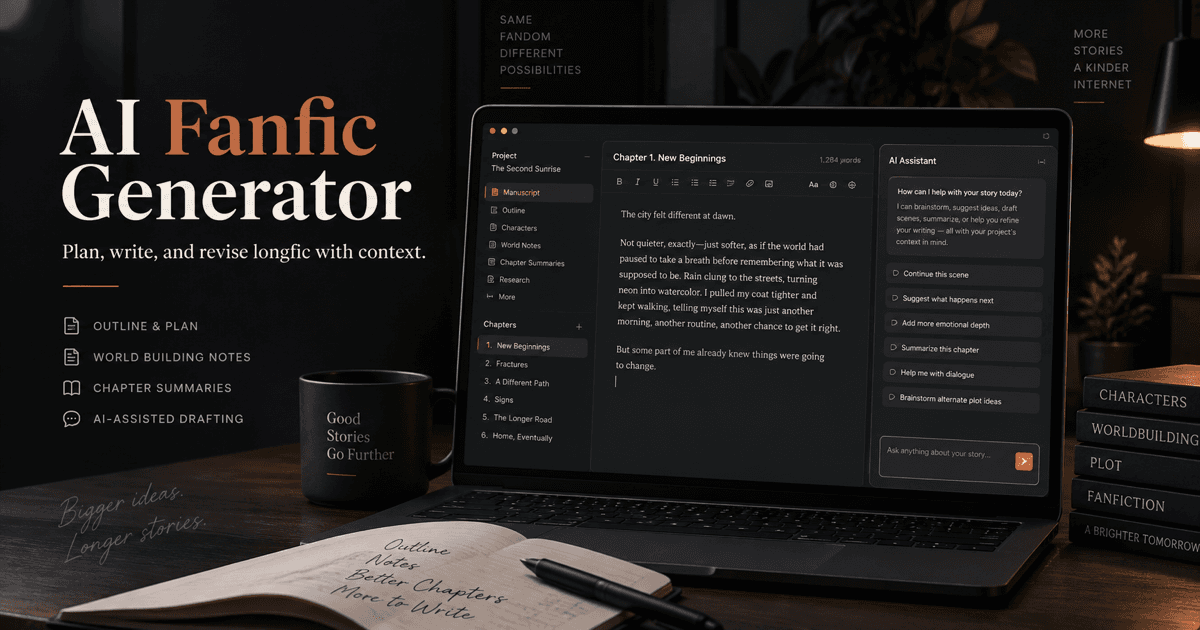
AI Fanfic Generator is built for fanfiction scenes first, which makes it different from many generic AI story writer sites. The prompt flow focuses on fandom context, character dynamics, tropes, tone, and scene pressure, then turns those inputs into an editable opening draft.
That matters because fanfiction has its own writing problems. A good fanfic scene needs to respect canon notes, relationship tension, ship dynamics, alternate universe rules, and pacing. AI Fanfic Generator is especially useful when you want to draft a scene starter, continue a longfic idea, or keep chapter notes close to the writing process.
It is less suitable if you want a broad business-writing assistant or a visual storybook maker. Its advantage is narrower and more useful for the right reader: it treats fanfic as a real writing workflow, not just a generic story prompt.
Best for: fanfic writers who want an AI fanfiction generator with scene prompts, project context, and longfic-friendly drafting.
3. NovelAI
NovelAI is a good choice for writers who enjoy interactive story continuation and deeper context controls. Its official Lorebook documentation explains how entries can store supplemental information about characters, places, objects, factions, and other story elements, then bring that information into generation when relevant.
That makes NovelAI useful for fantasy, roleplay-style writing, fanfiction experiments, and worldbuilding-heavy stories. The tool rewards writers who are willing to build lore entries, memory notes, and author instructions instead of asking the AI to guess everything from one prompt.
The main limitation is setup friction. If you do not maintain your context, a long story can still drift. NovelAI works best when you treat it as a co-writing environment and keep your story information tidy.
Best for: writers who want interactive AI fiction writing tools with lore, memory, and story-continuation controls.
4. Novelcrafter
Novelcrafter is best for writers who want AI help inside a structured novel-planning workspace. Its feature list includes a Codex story bible, worldbuilding tools, outlines, scene beats, AI chat, scene summarization, custom prompts, revision history, and export options.
This is more than a simple AI story generator. Novelcrafter is closer to AI novel writing software for people managing a manuscript, cast, locations, lore, and scene-by-scene development. The Codex approach is useful when you need the AI to reference the right character or world detail without stuffing every note into the prompt manually.
The trade-off is complexity. A casual user may not need this much structure. For a serious novel, series, or lore-heavy project, that structure is the point.
Best for: novelists who need story organization, character tracking, worldbuilding, and AI assistance in one writing environment.
5. Squibler
Squibler positions itself as an AI book and novel writer for books, novels, and screenplays. Its official page highlights full-length book generation, screenplay generation, story outline generation, AI Smart Writer, elements creation, and visuals generation.
Squibler is useful when you want a guided path from idea to structured draft. It can help writers who feel stuck before the outline stage or who want a more project-based writing tool than a general chatbot.
The trade-off is control. A tool that promises fast full-length generation still needs human revision, scene judgment, and voice editing. Use Squibler to build momentum, then revise carefully.
Best for: writers who want a fast draft framework for books, novels, or screenplays.
6. Story.com
Story.com is a strong option when your story is not only text. Its AI story page describes story generation across genres, interactive choices, AI storybooks, and paths from story drafts into videos or visual media.
That makes it useful for creators who want bedtime stories, illustrated storybooks, interactive narratives, social video ideas, or visual storytelling projects. It is less focused on the traditional novelist's manuscript workflow and more focused on turning a story idea into a media object.
If you want a polished prose chapter, start elsewhere. If you want story plus images, branching, or video planning, Story.com is worth testing.
Best for: creators who want AI stories that can become storybooks, interactive narratives, or videos.
7. Canva AI Story Generator
Canva's AI Story Generator is useful when writing is part of a visual project. It runs through Magic Write inside Canva Docs and can help generate story ideas, short drafts, outlines, and rewritten text.
The biggest advantage is the surrounding Canva ecosystem. You can draft a short story, add visuals, collaborate in a document, and turn the result into a designed asset. This is useful for educators, content creators, children's story projects, presentations, and brand storytelling.
Canva is not the best choice for long manuscripts. Canva's own story-generator FAQ says Magic Write has a 500-word output limit, so treat it as a short-form drafting and ideation tool rather than a full book writer.
Best for: short AI stories, visual storytelling, classroom-style projects, and story drafts that need design.
8. Rytr AI Story Generator
Rytr's AI Story Generator is a quick way to generate plots and story ideas. Its official page describes a workflow where you choose language, tone, the Plot Generator use case, and an input phrase or keyword before generating output.
Rytr works well when you want a premise, a twist, a genre seed, or a simple outline. It is also useful for writers who want tone options and multilingual support without learning a heavier fiction platform.
It is less ideal for long-form continuity. Use it for story sparks, then move the idea into a deeper writing tool if you plan to write chapters.
Best for: fast plot ideas, short story prompts, and lightweight AI story writing in different tones.
9. Writecream Story Writer
Writecream Story Writer is a broad AI writing site with a dedicated story writer tool. The page lets users enter a story topic, choose language and tone, set word count, and generate a draft.
This is a practical option for quick writing experiments, beginner story drafts, or creators who already use Writecream's wider content tools. It is not as fiction-specialized as Sudowrite, NovelAI, or Novelcrafter, but it can still help with a first pass when speed matters more than deep story structure.
The limitation is that broad AI writing tools can sound generic unless you give them specific characters, conflict, setting, and style notes. For better output, provide a detailed prompt rather than a one-line idea.
Best for: quick AI story drafts and users who want story writing alongside other content templates.
10. ToolBaz AI Story Generator
ToolBaz AI Story Generator is a free, no-login story generator with fields for character details, setting, format, length, genre, narrative perspective, audience, tone, and additional notes.
That makes it a useful lightweight option when you want to test a story idea without building a full account or project. It is also convenient for simple prompts such as bedtime stories, fantasy scenes, RPG backstories, and creative-writing exercises.
The trade-off is consistency. Free prompt-based generators can produce uneven prose, especially for longer stories. Give ToolBaz clear inputs and treat the result as draft material, not finished writing.
Best for: free AI story generation, quick experiments, and simple creative prompts.
Which AI Story Writer Should You Use?
Pick the tool based on the job:
- Choose Sudowrite if you want a fiction-first writing suite for drafting and revision.
- Choose AI Fanfic Generator if your story is fanfiction, ship-focused, trope-driven, or part of a longfic project.
- Choose NovelAI if you like interactive continuation with lore and memory controls.
- Choose Novelcrafter if you need a structured story bible and manuscript workspace.
- Choose Squibler if you want a guided path toward a book, novel, or screenplay draft.
- Choose Story.com if you want stories that can become storybooks, interactive narratives, or videos.
- Choose Canva if your story draft needs design, visuals, or collaboration.
- Choose Rytr, Writecream, or ToolBaz if you mainly need quick prompts, plots, and short drafts.
For serious writing, the best workflow is often a combination. Use one tool to plan, another to draft, and your own editing judgment to make the story feel alive.
Prompt Template for Better AI Story Output
Most AI story writing tools improve when you give them story pressure instead of a vague request. Use this template when a site gives you an open prompt box:
Genre:
Premise:
Main character:
Goal:
Conflict:
Setting:
Point of view:
Tone:
Important backstory:
Scene objective:
Things to avoid:
Target length:
Example:
Genre: cozy fantasy
Premise: a retired dragon accountant opens a tea shop in a city full of cursed ledgers
Main character: a careful, anxious dragon who misses adventure but fears chaos
Goal: keep the shop open during inspection week
Conflict: one ledger begins rewriting customer memories
Setting: a canal city with floating markets
Point of view: close third person
Tone: warm, witty, lightly mysterious
Important backstory: the dragon left the royal treasury after a scandal
Scene objective: introduce the first cursed customer
Things to avoid: slapstick, modern slang, instant romance
Target length: 900 words
The "things to avoid" line is especially useful. It keeps the AI from drifting into default tropes that do not fit your story.
FAQ
What is the best AI story writing tool overall?
Sudowrite is the strongest overall pick for fiction writers who want a dedicated writing workflow. AI Fanfic Generator is the better pick for fanfiction, while NovelAI and Novelcrafter are stronger for lore-heavy and long-form projects.
What is the best free AI story generator?
ToolBaz is useful for free, no-login story generation, and Canva offers limited Magic Write access for short drafts. Free tools are best for ideas and rough drafts; longer fiction usually needs more context control and editing.
Is AI Fanfic Generator only for fanfiction?
It is designed around fanfiction workflows, but the same structure can help with original character scenes, relationship dynamics, tropes, and scene starters. It is most valuable when you care about character context and emotional setup.
Can AI write a full novel?
Some tools can generate long drafts or chapter structures, but a publishable novel still needs human planning, editing, continuity checks, and voice work. AI can help you move faster, but it should not replace your judgment.
Are AI story writing tools safe for private drafts?
Privacy depends on the tool. Before uploading unpublished work, check the site's privacy policy, data controls, retention rules, and whether your content may be used for model improvement. Avoid uploading someone else's writing without permission.
Conclusion
The best AI story writing tools are the ones that match your story workflow. Sudowrite is the strongest fiction-writing suite, AI Fanfic Generator is the most focused option for fanfic scenes and longfic context, NovelAI and Novelcrafter are better for lore-heavy projects, and simpler sites such as Rytr, Writecream, and ToolBaz are useful for quick ideas.
Use AI to get unstuck, explore variations, and build momentum. Then revise like a writer: check the logic, sharpen the voice, protect your characters, and make the final story yours.